




Ask any cinematographer what matters more, the camera or the lens, and most will say the lens. The camera records the picture. The lens decides what the picture feels like: how wide the world is, how close the face is, how soft the background melts away.
Choosing a lens gets easier once you understand two numbers printed on it: the focal length (in mm) and the aperture (the f-number). Deepika (Insight Keti), co-founder of Inside, explains how to choose in this lesson, watched half a million times on our Instagram:
Watch: How to choose the best lens (Inside Film Institute on Instagram)
What does focal length mean?
Focal length tells you how much of the scene the lens sees. A smaller number sees more (wide). A bigger number sees less but brings things closer (tele). In the reel, Deepika sorts lenses into three simple categories:
| Category | Focal length (full frame) | Good for |
|---|---|---|
| 1. Wide-angle | below 35mm | landscapes, architecture, interiors, establishing shots |
| 2. Standard | 35mm to 85mm | events, people, everyday scenes; close to how our eyes see |
| 3. Telephoto | above 85mm (like a 70-200mm) | wildlife, sports, faces from a distance, compressing a far background |
Wide lenses stretch the space and make things near the lens look bigger. Long lenses squeeze the space, so the background looks closer and bigger behind the subject. That’s why the same face looks different on a 24mm and an 85mm.
Why aperture matters when you buy a lens
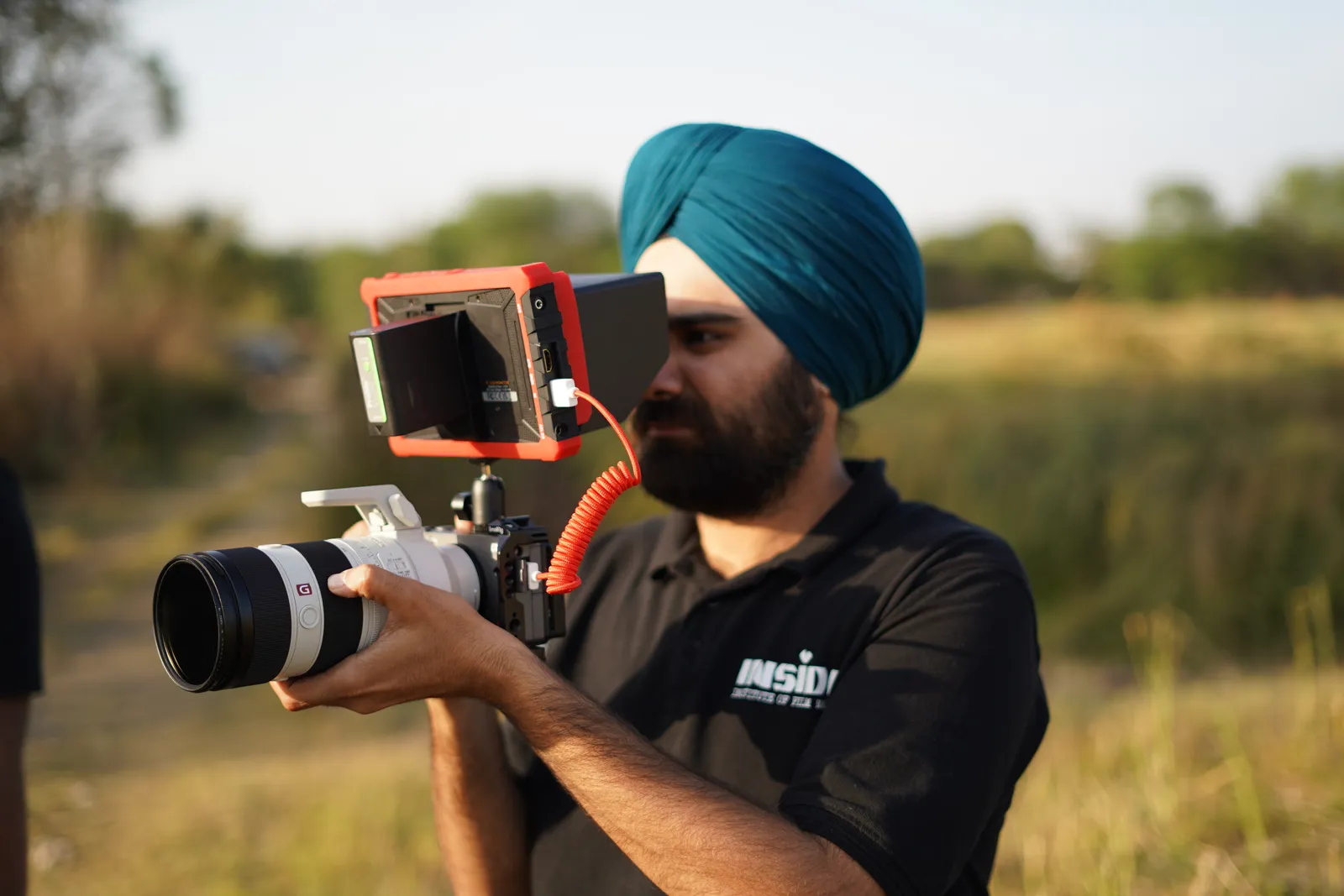
Every lens has a widest aperture, like f/1.4, f/1.8 or f/4. A wider aperture (a smaller number) lets in more light, so you can shoot in dim places, and it gives a softer, blurrier background. These are called fast lenses. If aperture is new to you, read What Is the Exposure Triangle? first.
Prime or zoom?
- Prime lens: one fixed focal length (like 50mm). Usually sharper, lighter and faster (wider aperture). You “zoom” with your feet.
- Zoom lens: a range (like 24-70mm). Flexible and quick to work with when you can’t move, such as at events or in documentary.
Many filmmakers shoot drama on primes for their look, and keep a zoom for speed.
What’s the best lens for portraits?
For a portrait, two things matter: a longer focal length, so you can stand back and the face isn’t stretched, and a wide aperture like f/1.8 or f/1.4, so the background melts into soft blur. In this lesson, Deepika shows the same idea on a 70-200mm at f/2.8 and on a 50mm at f/1.2. Many photographers also love an 85mm for faces, and a 50mm is a great first portrait lens:
Watch: The best lens for portraits (Instagram)
How to choose your lens, step by step
- What do you shoot most? Faces, places, action or events?
- How much light will you have? Indoors and at night, a fast lens (f/1.8 or wider) helps a lot.
- Does it fit your camera? Check the mount, and whether your sensor is full frame or crop (a crop sensor makes a lens look “longer”).
- Try before you buy. Rent it for a shoot or borrow one. Our guide on buying or renting a camera works for lenses too.
Some lenses are pure fun. On one of our music video shoots, the crew used a probe lens: a long, thin lens that can go right into a scene, between objects, for shots a normal lens can’t get. Every lens is a new way of seeing.
Learn focal length in 15 minutes
- Stand a friend in front of a background and frame them head to waist on a wide lens (or phone 0.5x).
- Walk back and frame them the same size on a longer lens (or phone 2x–3x).
- Compare the two backgrounds: the longer lens makes them look closer and bigger.
- Note which one fits a portrait, and which one fits a location shot.
- Focal length decides how wide the view is and how the background looks.
- Wide (under 35mm), standard (35–85mm), telephoto (above 85mm).
- A wide aperture (low f-number) gives a soft background and works in low light.
- Primes are sharp and fast; zooms are flexible.
Frequently asked questions
Which lens is best for beginners?
A 50mm prime (often f/1.8) is a great first lens: sharp, light, good in low light and close to how our eyes see.
Is 50mm or 85mm better for portraits?
85mm usually gives a more flattering face and a softer background. 50mm is more flexible indoors, where you can’t step far back.
What does f/1.8 mean on a lens?
It’s the widest aperture the lens can open to. The smaller the number, the more light it lets in and the blurrier the background can be.
Prime or zoom for filmmaking?
Primes give a cleaner look and work better in low light. Zooms save time when you can’t move or change lenses quickly.
Do I need an expensive lens to start?
No. Learn what different focal lengths do first. Renting for a shoot is a smart way to try lenses.
Learn it on a real set
At Inside Film Institute in Panchkula, students don’t just read about lenses. They mount them on cinema cameras, pull focus and compare shots on real films and web series made by Inside Motion Pictures. See Pro Cinema and Pro Filmmaking, and when you’re ready, take the first step.
We Love Cinema.
Rate this blog
Know someone who loves cinema? Send them this.
Comments
No comments yet. Be the first to share a thought.


